A New Approach to Understanding Mathematics
Mathematics becomes easier when children can see, touch, and interact with numbers instead of simply memorizing them. Traditional learning methods often introduce symbols before concepts, making math feel abstract and difficult for many young learners.
This is where Kid Advance Montessori – Montessori Math Materials create a completely different learning experience. These hands-on tools allow children to hold quantities, arrange numbers, and physically explore mathematical relationships before moving toward abstract calculations. The learning process moves naturally from concrete experiences to symbolic understanding, helping children develop deeper mathematical confidence.
The Philosophy Behind Montessori Mathematics
Montessori mathematics education begins with real objects that children can manipulate and observe. Beads, rods, tiles, counters, and cards help learners understand quantity in a visible and tangible way.
Instead of focusing on memorization alone, children are encouraged to discover mathematical concepts through exploration and repetition. This process helps create long-term understanding rather than short-term recall. Mathematical ideas become meaningful because children experience them directly rather than simply hearing explanations.
Building Mathematical Skills Step by Step
One of the defining characteristics of Montessori mathematics is the carefully designed sequence of learning materials. Each activity prepares children for the next level of understanding.
The progression begins with simple quantity recognition and gradually advances toward operations, place value, multiplication, and fractions. Because every material has a specific educational purpose, children can move through mathematics with confidence and consistency.
Numerical Rods Create Early Number Awareness
Numerical Rods are among the first mathematical tools introduced to young learners. These rods help children visually understand the relationship between quantity and size.
By arranging rods from shortest to longest, children begin recognizing numerical order while physically experiencing the difference between numbers. Rather than memorizing that ten is larger than five, children can actually see and feel the difference through the material itself.
Sandpaper Numbers Connect Symbols and Quantity
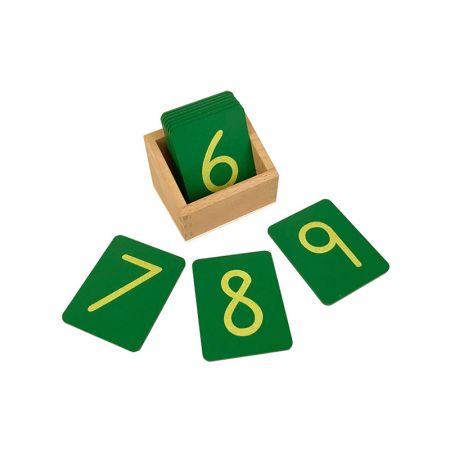
After understanding quantity, children are introduced to number symbols using Sandpaper Numbers. These tactile materials allow children to trace each numeral while associating it with its spoken sound and corresponding quantity.
The multi-sensory approach combines touch, sight, and hearing, making number recognition more engaging and memorable. Toddler versions and standard versions of these materials support different developmental stages and learning needs.
Spindle Boxes Introduce the Concept of Zero
Understanding zero can be difficult for young learners because it represents the absence of quantity rather than a visible amount.
Spindle Boxes help children group objects according to numerical values while demonstrating that the compartment labeled zero remains empty. This simple activity creates a powerful understanding of one of mathematics’ most important concepts.
Cards and Counters Reinforce Counting Skills
Cards and Counters provide opportunities for children to match numerical symbols with physical objects. Learners place counters beneath number cards while observing patterns and relationships.
This activity strengthens one-to-one correspondence while helping children recognize odd and even numbers naturally through arrangement and observation.
Exploring Place Value Through Number Cards
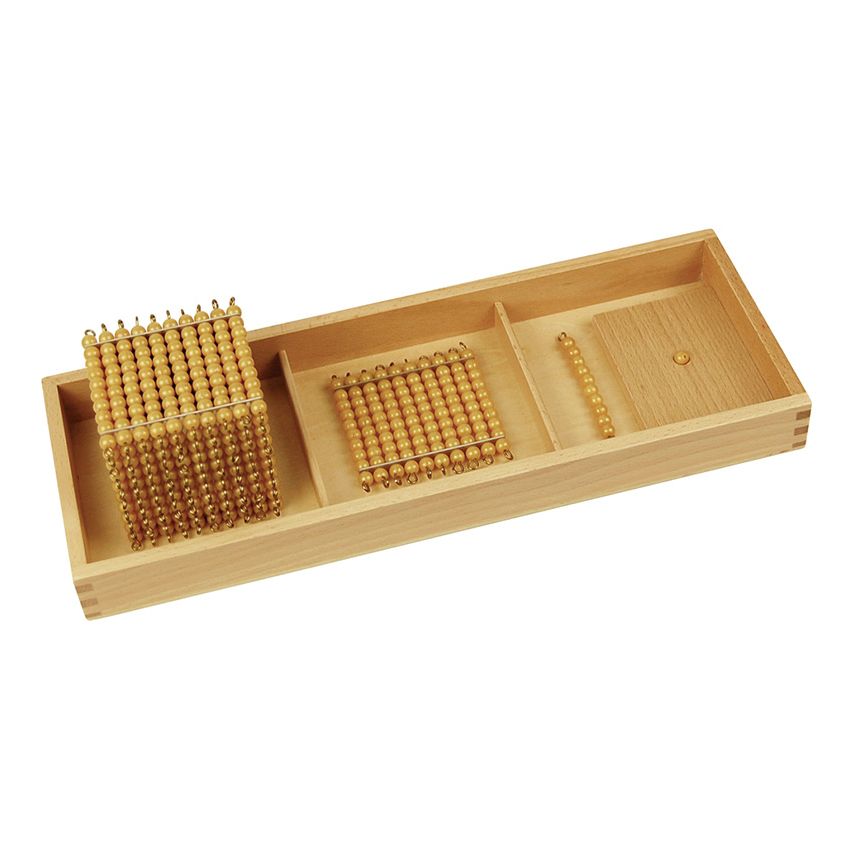
Place value often becomes challenging when introduced only through written exercises. Montessori mathematics addresses this challenge through large and small number cards representing values from one to nine thousand.
Children can physically build numbers and separate units, tens, hundreds, and thousands, making the decimal system easier to understand. By manipulating cards directly, learners develop a stronger grasp of numerical structure and composition.
Bead Frames Support Advanced Calculations
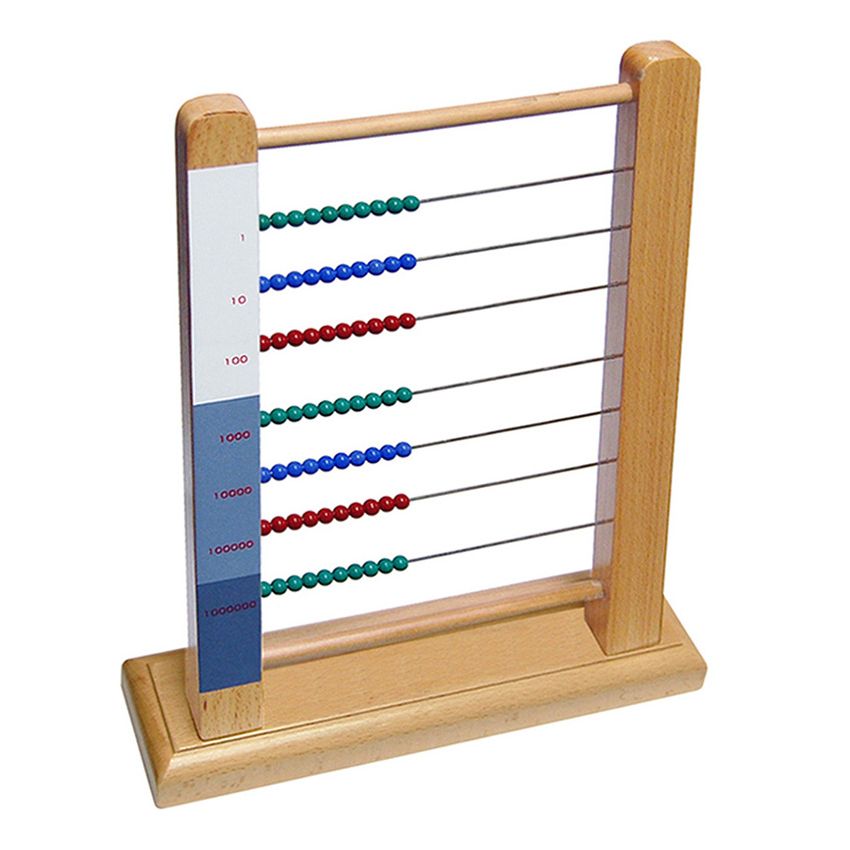
As children progress, Bead Frames become valuable tools for performing increasingly complex calculations.
Both small and large bead frames help learners visualize operations while strengthening mental arithmetic skills. Because calculations remain visible throughout the process, children can follow each step and understand how answers are formed rather than relying solely on memorized procedures.
The Stamp Game Makes Operations Concrete
Addition, subtraction, multiplication, and division can seem overwhelming when introduced as abstract symbols. The Stamp Game transforms these operations into physical experiences using manipulatives that represent place values.
Children move pieces, combine quantities, exchange values, and solve problems through active participation. This approach supports understanding while reducing anxiety around mathematics.
Learning Beyond Memorization
One of the most important benefits of Montessori mathematics is the emphasis on genuine understanding. Children are encouraged to explore concepts until they can explain and apply them independently.
Because materials include opportunities for self-correction, learners can identify mistakes and improve without relying entirely on adult instruction. This builds independence, confidence, and problem-solving ability alongside mathematical knowledge.
Supporting Multiple Age Groups
Montessori mathematical materials are designed to support children throughout different stages of development.
The collection includes materials suitable for toddlers discovering numbers for the first time, preschool learners exploring operations and place value, and elementary students advancing into multiplication and fractions. This developmental progression ensures continuity in learning while maintaining appropriate levels of challenge.
The Future of Mathematics Learning
Children learn mathematics most effectively when concepts are meaningful, visual, and interactive. Montessori mathematics transforms numbers from abstract symbols into experiences children can explore with curiosity and confidence.
By moving from concrete materials to abstract understanding, learners build mathematical foundations that support future academic success while maintaining a positive relationship with numbers and problem-solving.
Frequently Asked Questions
1. What are Montessori Math Materials?
Montessori Math Materials are hands-on educational tools that help children understand numbers, quantity, operations, and mathematical concepts through physical interaction and exploration.
2. Which materials are used to introduce numbers to beginners?
Numerical Rods, Sandpaper Numbers, Printed Numeral Wooden Cards, and Number Puzzles are commonly used for early number learning.
3. How do children learn place value using Montessori mathematics?
Large and small number cards representing values from 1 to 9000 help children understand units, tens, hundreds, and thousands visually and physically.
4. What materials help children practice mathematical operations?
The Arithmetic Signs Box, Bead Frames, and Stamp Game are commonly used to introduce addition, subtraction, multiplication, and division concepts.
5. Are Montessori mathematics materials suitable for different age groups?
Yes. The materials support multiple developmental stages ranging from early childhood through elementary years with progressively advanced concepts and activities.

